0

Wireless systems in the Smart Home: your path to an intelligent home

Imagine your home responding to your needs. In recent years, the Smart Home has evolved from a technical gimmick to a real convenience factor. Modern wireless systems make the integration of intelligent solutions easier than ever before.

Why a Smart Home with a wireless system?
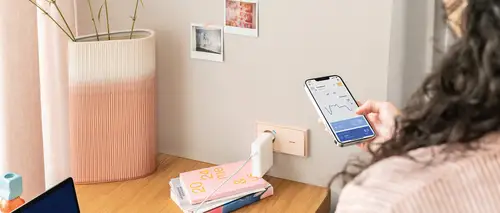
  • Comfort: Imagine coming home after a long day and your home welcomes you with cosy warmth and dimmed light. This is just one of the many ways in which a Smart Home can make your everyday life easier.

  • Security: With a smart home system, you can monitor your doors and windows, detect movement and even simulate that you are at home when you are on holiday.
  • Energy efficiency: Smart thermostats and sockets help you save energy by only activating the heating and lighting when they are actually needed.

  • Future-proof: Wireless systems are flexible and can be easily expanded. This means you can customise your Smart Home as you wish and build on new technologies.

What is a wireless system for the Smart Home?

A wireless system is like an invisible network that connects your Smart Home devices. It enables wireless communication between different devices without the need to lay cables. For example, a smart socket can communicate with a thermostat to turn down the heating when a device is no longer connected. This communication takes place via wireless standards such as Zigbee, Z-Wave or WLAN.

Functions of a Smart Home with a wireless system

A Smart Home offers numerous functions that make everyday life easier and more efficient:
  • Automation: Routines can be set up to automate everyday tasks. For example, the light switches on when you enter a room or the heating is turned down when nobody is at home.
  • Energy saving: Smart thermostats adjust the heating power based on the outside temperature and daily routine. This means that heating is not switched on when the house is empty.
  • Remote control: Devices can be controlled from anywhere using an app. Forgotten lights or switched-on devices can be conveniently switched off while on the move.
  • Security: Wireless systems can be combined with security components such as cameras and motion detectors. Movements are recognised and it can be simulated that someone is at home to deter burglars.

Advantages of a wireless system

A wireless system offers many advantages that make it particularly interesting for new buildings and retrofits:
Installing a smart home system wirelessly is quick and uncomplicated. No complex cables need to be laid, which is particularly advantageous for existing buildings . Wireless systems can also be expanded at any time. New devices can be easily integrated into the existing system. If you move house, you can usually simply take your smart home devices with you , as they are easy to convert . Many wireless systems are compatible with devices from different manufacturers. This gives you greater choice and independence from specific providers. Security is of course also an important issue with wireless communication. Modern smart home systems offer various integrated into the earth protection such as encryption.

Safety aspects of wireless systems

Security is a particularly important issue for wireless communication. Modern systems offer various integrated into the earth protection:
Communication between the devices is usually encrypted to prevent unauthorised access to data and control commands. Various wireless standards (e.g. Zigbee, Z-Wave, WLAN) support different encryption methods such as AES (Advanced Encryption Standard). This is a widely used and robust encryption algorithm that is also used in many other areas, including KNX RF. Bluetooth® Mesh uses a symmetric encryption method. This means that both the transmitter and the receiver use the same key to encrypt and decrypt the data. Access restrictions are an important aspect on the user side: many systems only allow access to authorised users so that, for example, only certain people can take control of an app. Strong passwords are mandatory here. Regular software updates close known security gaps. It is important to always carry these out.

KNX SECURE ENCRYPTS THE SYSTEM ON THE DATA AND IP LINE

The convenience and possibilities of a Smart Home

Many things can be automated in the Smart Home, making everyday life much easier:
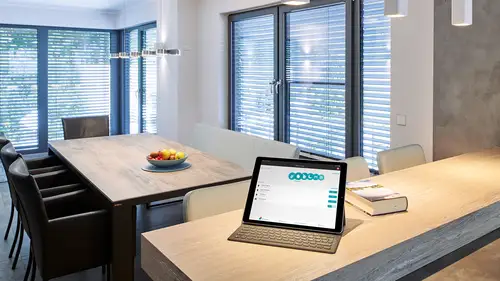
LIGHTING IS A CLASSIC EXAMPLE OF RADIO-CONTROLLED TECHNOLOGY
  • Smart lighting: Motion detectors, schedules or voice control make it easy to operate the lighting. Some systems even allow you to adjust the light colour.
  • Heating control: Smart thermostats learn the habits of the residents. Before returning home, they preheat the home to create a cosy ambience.
  • Smart sockets: They make it possible to integrate older devices into the Smart Home and control them via an app or automation system.
  • Voice control: Many systems can be connected to voice assistants so that you can switch on the light or adjust the temperature using voice commands.
KNX systems and their advantages
KNX is an internationally recognised standard for building automation. It is primarily used in larger construction projects and offers comprehensive control options. KNX systems can work both wired and wireless. Despite their complexity, they offer high stability and reliability.

What to look out for when buying a wireless system?
  • Compatibility: Ensure that all devices use the same wireless standard to guarantee smooth communication.
  • Range: Pay attention to the range of the radio signals. Walls and other obstacles can affect this. Repeaters can help to increase the signal strength.
  • Security features: Choose systems with strong encryption to prevent unauthorised access.
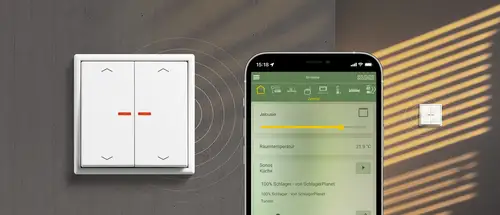
KNX RF BRIDGES ROOMS IN WHICH THERE ARE NO CABLES

Conclusion

A Smart Home with wireless systems offers a wide range of benefits, including greater convenience, increased security and improved energy efficiency. The simple installation and intuitive operation make it accessible to everyone. Whether you use a Smart Home thermostat to optimise heating or smart sockets to automate your devices, the possibilities are almost limitless. Thanks to the flexibility and expandability of wireless systems, you can optimally prepare your home for the future. Take the first step into the smart world and enjoy the benefits of an intelligent home.