0

JUNG KNX system: convenient and future-proof

Operate functions conveniently with a smartphone and voice control, automate daily processes and keep energy consumption in view: our intelligent KNX technology accompanies you unobtrusively through the day.
Solutions in the smart home and the smart building
  • Smart Home
    Live more conveniently
  • Smart Office
    Work more efficiently 
  • Hospitality
    Travel more pleasantly 
  • Healthcare
    Recover more quickly
The KNX system is the worldwide standard for professional and smart buildings and has been for over thirty years.
Independent of manufacturer, many possibilities are on offer to simplify your life: motion detectors register your route through the hallway and dimmed LED spots light your way. Sensors recognise if there is a window open in the living room and actuators turn down the heating. Elegant, sustainable and smart.
Operate on the move
In a KNX system, the operation of functions can be achieved in various ways. Naturally including the modern way with smartphone and tablet.
Voice control
"Hey, Alexa. Switch on the bathroom light": daily life works with an announcement with KNX. Easily operate all functions with voice commands. KNX is compatible with Alexa and Google Assistant.
Internet of Things
Light, music or energy consumption – modern building automation technology has many facets. For convenient networking, JUNG KNX connects to various solutions from the IoT.
Multimedia
Music in the whole house: the smart loudspeakers from Sonos also work perfectly with the Smart Visu Server.

KNX Smart Home: Visiting Dorothea Wierer

Dorothea Wierer won the overall World Cup twice and is a four-time world champion in biathlon. In the video she explains where she recharges her batteries for her sporting competitions and how KNX supports her.

What does what?

Manual sensors
Manual sensors allow operation by pressing a button or a rotary movement for rotary dimmers. The information is forwarded via the KNX bus to the implementing devices.
Automatic sensors
Presence detectors, weather stations and room thermostats utilise measured values and send a command for an appropriate function through the KNX system. 
Central control
The various KNX central control units form the node for networking and common operation of all functions, both room-related as well as for the entire building.
System components
For a tailored KNX system, the various KNX system components are essential. They are the interface to the programming and commissioning of the entire KNX system.
Actuators
Actuators receive information from sensors, run functions and feed back current states to the sensors. In the JUNG KNX system, there is a suitable actuator available for every application. 
Gateways
The gateways form the interface between KNX and an external system, such as the internal IP network. They translate the messages and allow the exchange of the data. 

Manual sensors

Smart functions, high quality materials and distinctive forms determine the JUNG design. The AS, A, CD and LS ranges give the control units their attractive look – fitting to the ambience.
The JUNG KNX system has the right solution for every function. On their characteristic information and labelling surfaces, KNX push-buttons provide plenty of space for individual labelling and thus make convenient operation possible. Rotary sensors simplify targeted control of lighting, and room controllers are versatile operating devices.
F 50 push-button
Large inscription field for intuitive operation: the F 50 push-button impresses with its operating concept. For example, the left button (or the upper, depending on installation) might switch the light on, the right button switches it off. Each button can control up to two functions. 
F 40 push-button
Four functions in one device instead of four individual switches on the wall: the F 40 push-button has large operating areas and each one can be allocated multiple functions. Individual labelling for ease of use.
F 10 push-button
With these push-buttons, technology and design form one unit that meets every demand: the F 10 push-buttons look like classic light switches but master smart KNX technology. Many functions in only one device.
Room controller F 50
Even in the version with one F 50 push-button, the room controller display module impresses with intuitive operation. The room temperature sensor and two integrated room thermostats allow precise measurement and exact regulation of the room temperature. 
Room controller F 40
Large buttons, clear display: the room controller impresses with an easily understood operating concept and inscribable buttons. You can see immediately on the display which functions you are controlling and which values you are changing. 
Rotary sensor
Ideal lighting conditions in no time. The design of the rotary dimmer has been known for many years and can be operated intuitively by all - also in the smart KNX system: from the conventional incandescent lamp to smart control with DALI. 
KNX RF
The KNX Radio Frequency (RF) radio standard in the JUNG design: the KNX RF technology is ideal for retrofitting and extending existing KNX systems. KNX RF devices bridge structural conditions where no bus lines can or will be installed. The flat wall transmitters can be flexibly and simply stuck in the room. With the KNX RF push-buttons, you replace a conventional light or blind switch.
KNX RF push-buttons
The KNX radio transmitters bridge structural conditions where no bus lines can or will be installed -  ideal for retrofitting or extending existing KNX systems.
KNX F 40 RF radio transmitter
The wall transmitters with a large inscription field bridge structural conditions where no bus lines can or will be installed.
KNX F 50 RF radio transmitter
The flexible wall transmitters with the large operating area can be freely located in the room as they are simply stuck on – whether on plaster, wood, or glass.
LS TOUCH
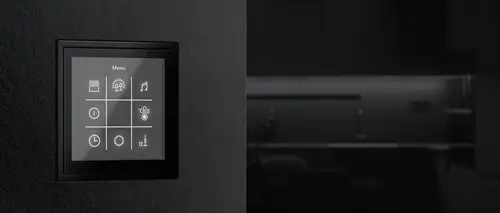
A device for comprehensive individual room control: The smart room controller LS TOUCH combines intuitive operation of KNX functions with visualization.


Automatic sensors

Discreet, compact, precise: that is what the JUNG KNX components are for automatic functions.
Automatic switches and presence detectors are designed to control lighting systems, room thermostats and numerous other electrical loads as needed. The numerous shapes, colours and high-quality materials of the A, CD and LS ranges leave nothing to be desired to adapt the sensors visually to the electrical installation. 
KNX automatic switch 1.10 m
The 180° detection range of the automatic switch is monitored by two PIR sensors that can be used individually or together. Ideal for use in small rooms or stairways.
KNX automatic switch 2.20 m
As an "observer with switch-off brightness", the automatic switch is ideally suited for use in offices. A further new performance characteristic of the devices is the integrated temperature sensor.
KNX room temperature controller
The room temperature controller detects and regulates the room temperature for efficient energy use. It therefore contributes a sustainable building automation.
Presence detector/ceiling observer.
When installed at heights of up to five metres, the device registers everything that is moving within a diameter of approx. 20 m. The detection angle of 360 degrees can be divided into three individual sensor areas.
KNX presence detector mini
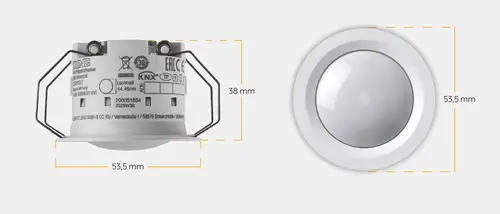
Discreet look, high performance: the KNX presence detector mini with integrated bus coupling unit provides control of building functions when needed. Its compact structure offers various options for ceiling installation.
The KNX weather station
In the KNX weather station with bus coupling unit, all critical sensors used to capture and evaluate meteorological data are incorporated in one compact design. 

The small KNX presence detectors impress with their variety of functions and precision.

JUNG has improved the built-in devices in all respects. The detectors are available in two technical and two optical variants: standard and universal, each in black with a dark lens or in white with a light lens.
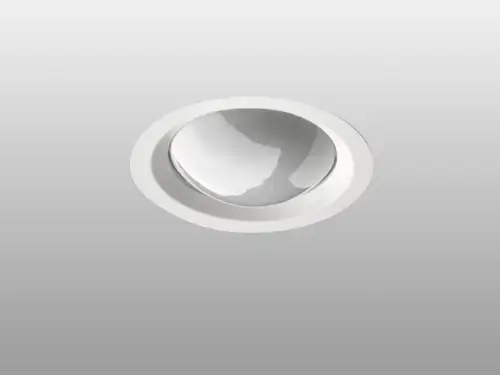
Presence detector in matt white

The white version is equipped with a light-coloured lens.

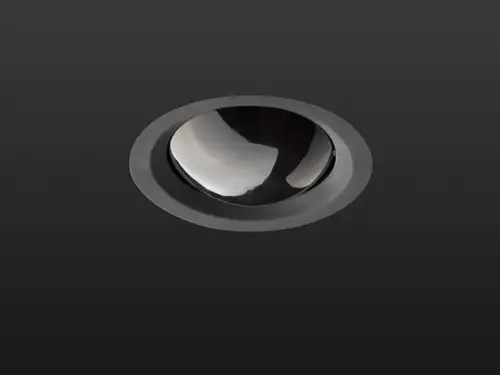
Presence detector in black

The black version is equipped with a dark lens.

Displays presence in desired RGB colour

The RGB LED acts as an status signal. When activated, the entire surface of the lens illuminated in colour. The colour can be selected individually. The brightness is adjustable in ten levels.

Ring segmentation

The presence detector usually detects a 360° area. Using the segment ring, individual areas of this detection range can be specifically covered so that the detector only reacts to movements in the desired zones.

Small installation depth

The shape of the KNX Mini presence detectors remains compact with unchanged installation dimensions that existing models can be easily replaced.

Faster configuration thanks to predefined function blocks in the ETS

Motion detector function block
Ideal for the use in corridors: the light switches on when people walk through the corridor and switches off again.
Presence detector function block
For example, for use in offices: light switches to office brightness when people are present.
Function block for heating, air conditioning, ventilation
It only switches the heating when someone is in the room. In air conditioning systems, the detector measures the dew point to protect the building from condensation.
Monitoring function block
The detector evaluates movements over a fixed time frame and only switches when a defined number of movements are detected. This means that the light remains switched off, if only the cat walks past.
Universal function block
Nothing is preconfigured in this block; all functions can be programmed individually here.

Central control

Visualise your KNX system with a touch display on your mobile device or on a signal panel.
Visualise and control the entire building technology using one device – with the JUNG display devices. Available in various formats, sizes and equipment features, completely according to individual requirements. Display and operation are performed conveniently using a touch screen via an intuitive user interface.
Smart Panel 8
The JUNG KNX touch display Smart Panel 8 is the solution for visualising and controlling your KNX system – without an additional server.
Smart Control 8
Convenience, functionality and security: the new JUNG Smart Control 8 is a capacitive touch display for controlling every function.
Smart Control 5
Compact touch display: thanks to a slim design, the Smart Control 5 fits into a conventional deep wall box.
Smart Visu Server
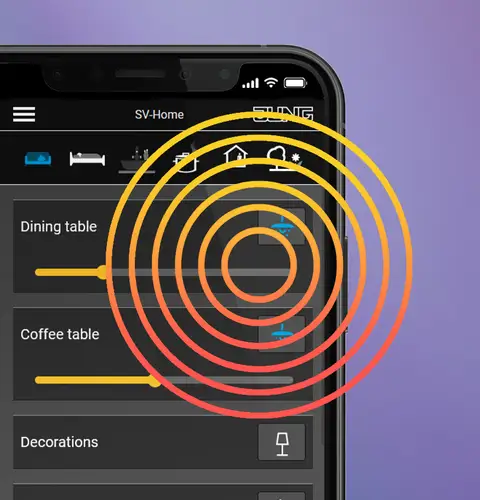
The JUNG Smart Visu Server raises the smart home to the next level. Visualise KNX processes on your smartphone or integrate existing house technology into smart technology.
Visu Pro Server
The JUNG Visu Pro Server visualises the KNX system in the demanding smart home or smart building using a browser or the app. It makes comprehensive individual adaptations of the complete system possible. 

Partnership with SmartThings

As a result of a so far unique cooperation, we are merging intelligent KNX building automation technology with the IoT world of Samsung. You profit from greater convenience and save energy and money.
As the first manufacturer, we are connecting the KNX field bus standard with SmartThings. You can now network your entire KNX building automation technology with SmartThings-compatible devices and control them using the SmartThings app.

Smart home meets IoT:

Use cases for JUNG KNX and SmartThings
Operation with the FamilyHub™
It is now possible to link a Samsung Family Hub™ with the Smart Visu Server. In this way, the individual functions in the smart home can be controlled at the touch display (Family Hub) of the refrigerator and even call scenes.
Light off, film on
It gets cosy completely automatically: as soon as the Samsung TV in the living room is switched on, it detects the JUNG KNX system. The KNX LED controller automatically dims the lighting in the living room to a comfortable brightness and nothing stands in the way of a film evening.

System components

The different KNX system components are important for building the bus structure and enable the commissioning of the KNX system. Our KNX portfolio has the right system component ready for every demand and thus enables different types of transmission paths and programming access – from extending the system using the line coupler to remote maintenance via the IP interface.
KNX area/line coupler
The KNX area and line coupler is a device for rail mounting with 1 rail unit. Compact and powerful, it offers a reliable solution for connecting two KNX lines while retaining electrical isolation, and also new functions from the ETS6. The KNX area and line coupler supports KNX Secure and can be updated using the ETS Service app.
KNX power supply with IP interface
The combination of power supply and IP interface merges two major systems into one component. With the power supply, installers can implement KNX installations more cost-effectively.
IP interface
The KNX IP interface links the installation with the IP network. The software upgrade IPS Remote also enables the remote maintenance of the KNX components outside the local network.
Radio converter
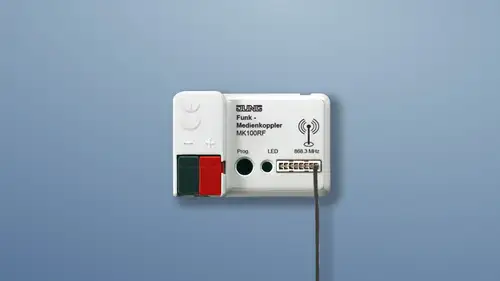
The JUNG KNX media coupler connects different transmission media with each other, e.g. wired and wireless devices. It is a translator and thus enables a uniform communication in the KNX system. 

Push-button interface

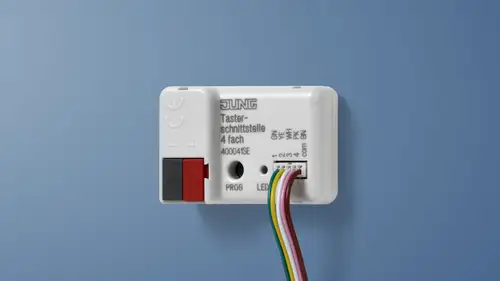
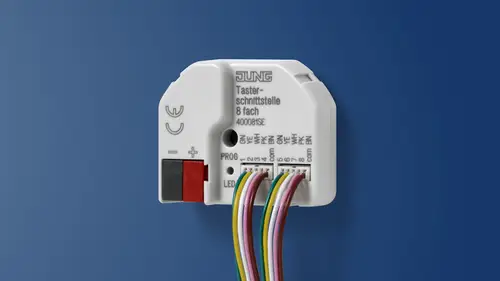
Instead of the previous cable length of five metres, the push-button interfaces now cover up to 30 metres. Parameterisation is simple and fast thanks to the clear operating area. Available in 2-gang, 4-gang and 8-gang.
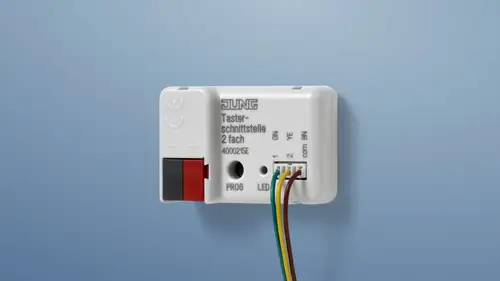
Push-button interface, 2-gang
Push-button interface, 4-gang
Push-button interface, 8-gang

KNX multi stations

The new JUNG KNX multi stations offer the full range of functionality of multiple individual devices in one compact housing.
They control light, blinds, heating or scenes – in either 4-rail or 8-rail versions. The reduced space requirement simplifies wiring and lowers costs for planning and installation. Both versions are fully compatible with KNX Secure.
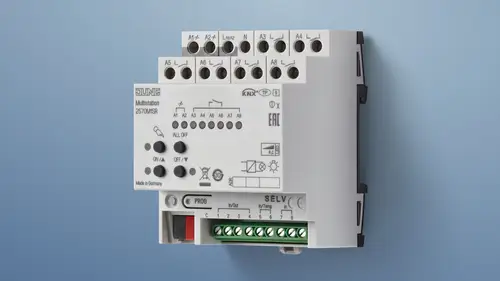
KNX multi station
The KNX multi station 2570 M1 SR is 4-rail units and offers eight outputs – two for dimming functions and six relay outputs. This allows lighting, blinds and valve drives to be combined flexibly. Two integrated HVAC controllers additionally allow precise control of temperature, fan levels and shading in one device – a versatile solution for standard applications in residential and functional buildings.
KNX multi station universal
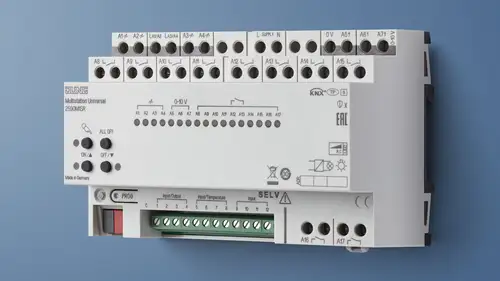
The KNX multi station universal 2590 M1 SR offers 17 outputs in one 8-rail unit housing. Four dimming channels, ten relay outputs and three analogue outputs (0–10 V) allow direct control of fans or continuous valve drives – ideal for projects with increased HVAC requirements. Comprehensive protection and diagnosis functions such as overload monitoring and mains voltage failure monitoring ensure reliable operation even in complex systems.
With the KNX multi stations universal and standard, JUNG expands its KNX portfolio with two compact solutions that combine multiple functions in a single device. Simplified wiring reduces installation effort and enables efficient installation. The benefits are presented in the video.

Actuators

They are the implementing devices in every KNX system: actuators receive information from sensors, execute commands and feed back current states to the display elements of the sensors. Appropriate actuators in different designs are available in the JUNG KNX system for every application.
KNX switch and blind actuators for flush-mounted installations
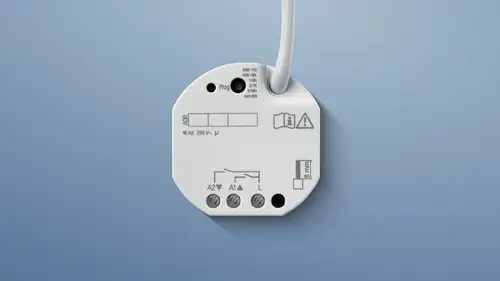
The flush-mounted actuators have a small size and a fully-fledged logic module that offers many connections and possibilities.
KNX heating actuator
KNX dimming actuators
Dimming actuators form the interface between the KNX bus system and the lighting. In this way, you always set the right accents and enable convenient lighting control.
KNX control unit
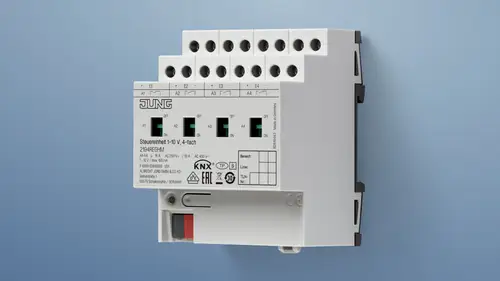
This actuator switches and dims electrical loads that have a 1-10 volt interface. The control unit has four individually controllable dimming channels.
KNX switch and blind actuators
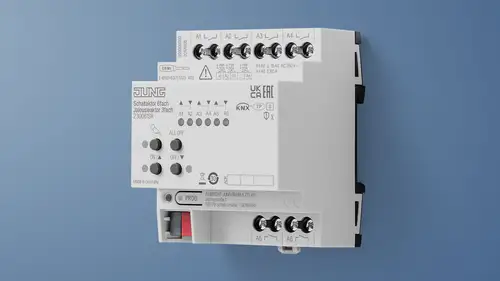
Teach-in function and eight independent logic functions: the actuators simplify installation and increase functional diversity while reducing energy consumption.
KNX fan coil actuator
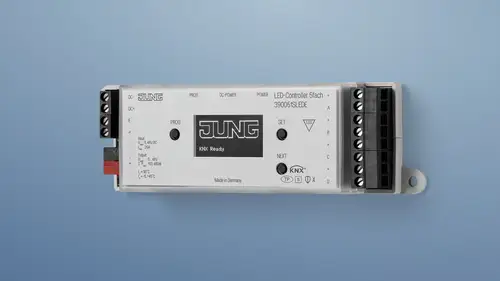
KNX LED controller
The KNX LED controllers are ideally suited to lighting in the home and control extra-low voltage LEDs without a transformer, such as LED strips. 

Gateways

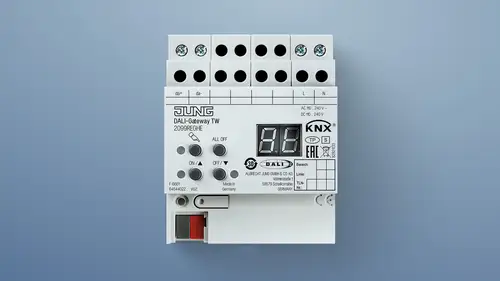
Smart connection of different systems: the JUNG gateways link your KNX system with the world of Sonos and enable the uniform and specific control of DALI lamps. In the process, they translate the incoming and outgoing messages and transfer the data of the two different networks. 
KNX DALI 2 gateway Colour 1-gang
KNX DALI 2 gateway Colour 2-gang
JUNG rail mounting data available in device data portals 
For efficient digital control cabinet planning with CAE software, JUNG now provides the device data for its for rail mounting devices via various device data portals. Planners can quickly insert the required components into their projects - including all relevant connections, symbols and metadata. This speeds up planning, ensures standard-compliant documentation and reduces sources of error.

Security in the KNX system

The discussion about data protection also does not stop at a smart building. Because everything you can operate digitally yourself, can theoretically also be controlled by unauthorised third parties. This is where JUNG KNX Secure comes in and provides effective protection thanks to encryption with the AES128 algorithm.
KNX Secure
The algorithm provides double protection and has two aspects: KNX IP Secure protects the data at the network level. In addition, KNX Data Secure encrypts and authenticates the telegrams in the system on the bus line (Twisted Pair) or using wireless communication (RF).
Secure remote maintenance
Simple and cost-efficient remote maintenance and programming of all KNX components: IPS-Remote makes it possible. The remote maintenance saves time for the expert and is convenient for the building owner. 

Living smartly with KNX

Katharina Beatriz Varga uses the JUNG showroom in Vilnius to illustrate what the future of living could look like in concrete terms.
Three projects and three impressive presentations in virtual reality (VR) that show JUNG KNX makes living more convenient and more secure.
From the optimum temperature and automated lighting to integration in the Internet of Things. KNX offers comprehensive, future-proof possibilities in building automation technology: from lighting and shading, via heating, air conditioning, monitoring and security to multimedia. In these virtual-reality applications, discover the worldwide smart-home standard and experience full immersion in intelligent living environments through a virtual tour of the KNX Smart Homes. Immerse yourself in an innovative world full of comfort and safety, made even more fascinating by the latest VR technology.
Apartment for singles/short-term accommodation
Smart technology in a small space: This is where special KNX-participants are used. Instead of heating actuators in the distribution box, motor control valves set the temperature. The KNX F 10 push-button provides simple operation. Experience an immersive VR tour of this smart apartment and convince yourself of the functions.
Apartment for couples
The challenge with this bright apartment was in the combination of the modern building technology with simple operation. Throughout the apartment the JUNG KNX F40 push-button can be found. The JUNG LS 990 switch range puts the electrical installation into the scene. Enter this smart apartment with the help of VR and experience the numerous smart home features. 
Freehold apartment for families
LS 990 and LS ZERO in white and classic brass impart a high-quality and restrained look to the property. The apartment combines building technology with a particularly intuitive control system. Explore this innovative KNX object in VR and get convinced by the future-oriented technology.

Discover the Live Services from JUNG

JUNG GRAPHIC TOOL
Create individually switches, sockets, KNX buttons, room controllers and more according to your ideas. The operating elements can be customised online with symbols, text or logos.
JUNG Showrooms
You have the opportunity of experiencing our products and building technology in showrooms & brand stores.

JUNG Newsletter

Product news, architecture references and smart home trends: With our JUNG newsletters you are always well informed when it comes to trends and news.

Contacts

Do you have any questions, requests, or suggestions about our products and solutions? Please contact us. We hope we can help you!

FAQ - Frequently Asked Questions about: KNX building technology

For new builds and refurbishment, the JUNG KNX system is regarded worldwide as one of the future-proof and manufacturer-independent solutions for building automation. The open KNX standard enables components from different manufacturers to be connected within a single system. This allows lighting, shading, heating and other functions to be controlled flexibly and centrally. This is a decisive advantage, particularly for long-term planned residential construction projects and demanding commercial buildings. The system remains expandable, replaceable and technically compatible. The smart home solution is not tied to a single provider and can grow with the requirements of the building. The open system therefore provides a flexible and long-term reliable foundation for complex building automation, particularly in larger construction projects and demanding architectural projects.

The JUNG KNX system can be combined with a wide range of high-quality switch ranges. They offer reliable KNX compatibility and combine design, functionality and long-term planning reliability with precision. This allows JUNG KNX solutions to integrate seamlessly into different architectural concepts while providing a technically sophisticated foundation for demanding smart home and building automation projects.

JUNG switch ranges stand for a clear, timeless design language, high-quality materials and a consistent design approach. They support planners in implementing a consistent switch design in KNX building automation.

Strengths of JUNG switch designs in KNX environments

  • High-quality materials and precise workmanship
  • Wide choice of colours, shapes and finishes
  • Reliable KNX compatibility
  • Harmonious integration into residential architecture, hotels and demanding commercial buildings
  • High planning and expansion reliability
  • Coherent combination of technology and design

With flush-mounted solutions, coordinated colour systems and a wide range of finishes, technical requirements can be translated into high-quality design. In addition, the exclusive Les Couleurs® Le Corbusier® colour range can be integrated into architectural colour concepts.

Durability, robustness and permanently precise mechanics represent quality in everyday use. Particularly in high-end residential and commercial buildings, solutions are created in which the technology does not take centre stage but integrates elegantly into the overall architectural concept.

JUNG combines functional precision with understated design, creating switch solutions that are convincing in KNX environments both technically and aesthetically, thereby providing a reliable foundation for modern smart home and building automation concepts.

A KNX system can be planned on a modular basis and built up step by step. It can also be expanded at any time. Additional functions such as KNX Secure, operating elements such as Smart Panel 8 or Smart Control 5, as well as display devices and visualisation solutions, are integrated according to the project requirements. This keeps the system flexible, future-proof and compatible with new applications and extensions over the long term.

KNX is an open, manufacturer-independent standard for building automation. This gives the system a high level of planning and investment security throughout all project phases. Unlike many proprietary solutions, KNX is particularly scalable and can be adapted flexibly to different building structures and usage scenarios.

The system can be combined with a wide variety of components and user interfaces, for example with switch ranges or proprietary smart home systems. JUNG HOME can be linked with KNX functions via the JUNG HOME Gateway and the Smart Visu Server and can therefore be integrated into a comprehensive building automation system.

For demanding construction projects, KNX is less a question of whether and more a question of when. As a manufacturer-independent, standardised bus system, KNX forms the technical backbone on which JUNG consistently builds its switching and control solutions. Planners and architects in particular benefit from clearly structured, scalable building automation.

  • Preserving property value
    A KNX bus system, once installed, remains functional for decades and can be expanded independently of the end devices used. This means the investment in the building infrastructure is protected over the long term and remains technically future-proof.
  • Scalability for large projects
    In buildings with a high level of technical complexity, such as hotels, hospitals or yachts, KNX demonstrates its strengths. A central bus cabling system replaces numerous individual control systems, making large installations easier to plan, clearly document and maintain over the long term.
  • Efficient building automation
    Lighting, shading and heating can be controlled centrally and according to demand instead of via separate individual systems. This supports certifications and sustainability assessments and creates a reliable foundation for efficient building technology. You can read how KNX can also be integrated with photovoltaic systems, heat pumps and wallboxes in the following question in the next section.

Tip for the initial installation
Anyone who plans a well-designed line structure and sufficiently sized distribution boards during the initial installation will avoid later conversions and retain maximum flexibility for future extensions to the KNX system. This simplifies the planning of complex projects and provides capacity for additional functions.

This is precisely one of the key advantages of an open bus system such as KNX: instead of several isolated standalone solutions with separate apps, all relevant energy components are controlled via a single platform.

  • Photovoltaic systems
    Via suitable interfaces, the inverter transmits its generation data to the KNX system. Consumers within the building can then be activated specifically when sufficient solar power is available.
  • Heat pump
    Many heat pumps have standardised interfaces through which they can be integrated into a KNX system. Operation can therefore be coordinated with current PV generation, occupant presence and time schedules.
  • Wallbox
    The charging capacity of a wallbox can also be integrated into a higher-level load management system via KNX. This allows charging processes to be shifted to periods with surplus PV generation and prevents peak loads at the building connection.
  • One system, one operating concept
    The decisive advantage for users is that whether controlling blinds, lighting, the heat pump or the wallbox, operation is carried out using the same JUNG switches, push-buttons or visualisations with central control. The design and operating concept remain consistent throughout.

For planning purposes, it is advisable to consider open, standardised interfaces for the energy components at an early stage. This ensures smooth KNX integration at a later stage and allows the various energy components to be integrated efficiently into the building concept.

Lighting and temperature demonstrate how intelligently the JUNG KNX system supports everyday life by combining comfort, security and energy efficiency.

  • Lighting scenes
    A single press of a button recalls a previously saved combination of brightness and colour temperature instead of controlling each light individually. Dimming is convenient and finely graduated to suit the respective usage scenario.
  • Presence simulation
    During periods of absence, for example while on holiday, the lighting switches on and off according to a realistic pattern. This makes the building appear occupied and an empty house significantly less unoccupied.
  • Room-by-room heating control
    Each room maintains its individually defined target temperature independently of neighbouring rooms. If someone opens a window, the control system responds automatically and adjusts the heating output accordingly.
  • Integration with schedules and sensors
    Blinds, heating and lighting can be linked to the time of day, outside temperature or the position of the sun. This enables the building to adapt automatically to current weather conditions and supports efficient, user-friendly building automation via KNX.

Yes, and over a long period. Devices from the first generation of KNX can still be combined with current components because the standard is continuously developed with backward compatibility. The ETS engineering software receives regular updates, while spare parts and extensions remain available for decades. For operators, this means that a system only needs to be planned once and does not have to be completely replaced every few years, but can continue to grow step by step.

For architecture and electrical planning, a consistent design is a strong argument in favour of JUNG as a manufacturer. KNX push-buttons such as F 10, F 40 or F 50 are not installed as separate, technical-looking elements, but are available in the same four switch ranges as the classic programmes: LS, A, AS and CD. Frames, rockers and covers remain identical. This allows conventional and smart switches to be installed side by side in the same room without creating a visual break in the wall design.

The selection is based on the same materials and colours as the classic ranges: depending on the series, frames and finishes are available in aluminium, stainless steel, chrome, gold or brass.

For manually operated push-buttons and the rotary sensor, there is an additional option: they are also available in the 63 original Les Couleurs® Le Corbusier® colours – the Polychromie Architecturale – hand-painted to create a particularly deep, matt colour effect.

Automatic components such as motion detectors, on the other hand, are available in the standard colours, where discreet, reliable functionality takes priority.

A special, usually green KNX bus cable is used for data transmission, a shielded two-core cable that is installed separately from the 230-volt power cables. This separation is not simply a nice-to-have, but protects the sensitive control signals from interference caused by the mains voltage. The number of these cable runs (lines) required in a building depends on its size. This should be determined during the electrical planning stage so that future extensions are not limited by insufficient cable capacity.

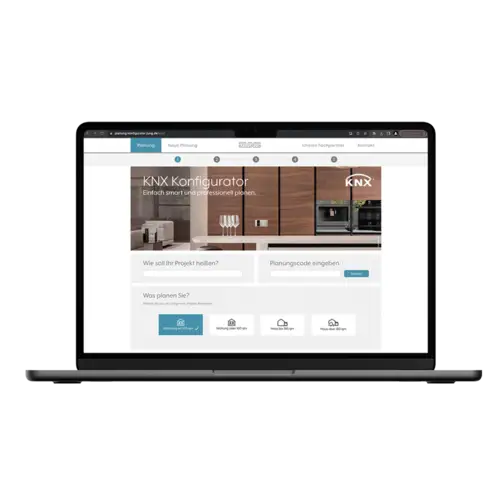
The basic principles of KNX are easy to understand, but detailed system planning should be carried out by a qualified system integrator. Using the ETS software, system integrators design KNX installations and link actuators and functions into a coherent overall system. For electrical planners, digital tools such as the JUNG KNX Configurator and integrated DIN rail (REG) data for CAE software significantly simplify the planning process, especially for larger projects with complex building automation requirements.

For homeowners, this means that you do not need to program KNX yourself. What matters is involving an experienced system integrator early in the planning process so that the desired functionality and future expandability of the system are considered from the outset.

The core of every KNX installation is the actuator. Actuators convert incoming control commands into switching actions, forming the central interface between system planning and the building's technical equipment.

  • Switch actuators control lighting and other electrical loads. They are available with different channel configurations, making them suitable for both small residential projects and large-scale commercial installations.
  • Blind actuators precisely and reliably control the movement and slat position of roller shutters, venetian blinds and awnings.
  • Heating actuators control thermal actuators for underfloor heating systems and radiators on a room-by-room basis, enabling precise individual temperature control in different zones.