Bildungslandschaft Altstadt Nord, Cologne| Germany
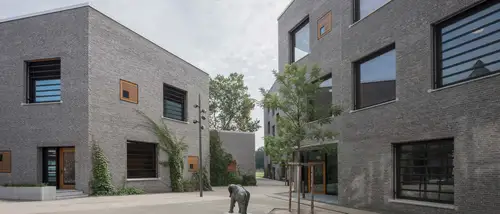
The Bildungslandschaft Altstadt Nord, or BAN, as a pilot project of the city of Cologne in cooperation with the Montag Stiftung Jugend und Gesellschaft is progressive in many respects. The three to five-floor collection of buildings bundles educational and training establishments, including a grammar school and evening school in existing buildings and a day-care centre for children, a primary school and a secondary school in new buildings and extensions by gernot schulz : architektur. The existing listed building for the primary school has been renovated and integrated into the new collection. In the future, a study centre plus canteen and studio building will be available for the around 2,200 pupils from all institutions in the form of a communal building.
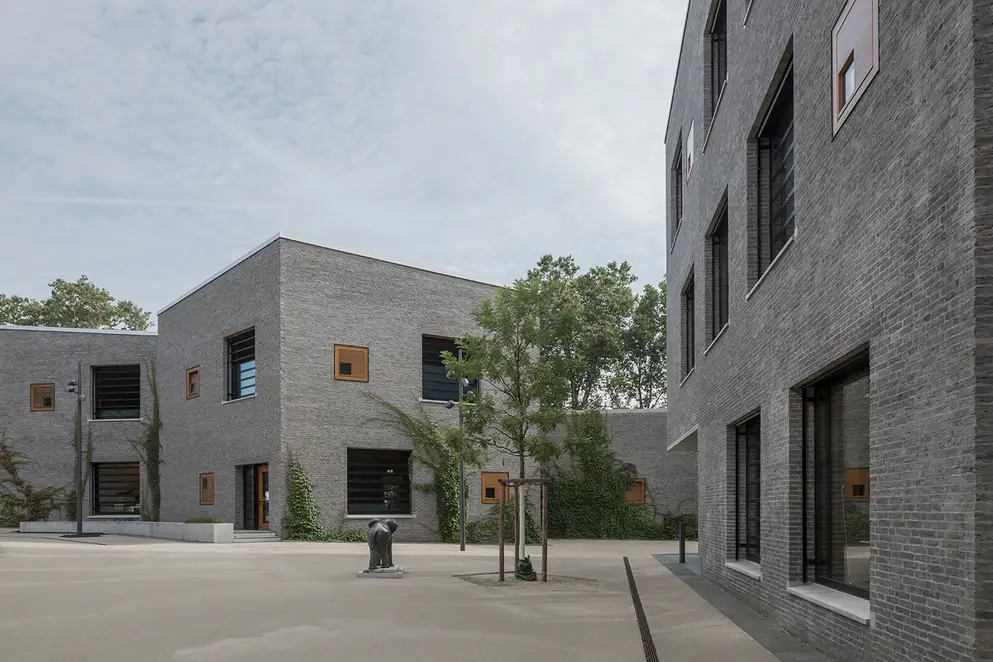
The pedagogical concept, marked by openness and dialogue, is supported by the architectural design: The new building volumes are based on pentagons apparently randomly placed next to each other. The façades of the irregular, stainless-steel cubes are covered in grey clay bricks. The building envelopes are characterised by three window formats: an oversized rectangle, a large square with horizontal sun-shade louvres and a small, wood-framed window element with ventilation flaps. The lively arrangement of the openings animates the façade and offers different views to the inside and outside. The experience of the building is characterised internally and externally by the changes in perspective. Every position allows a new perspective underlined by the arrangement of the windows, which appear to have been punched out of the solid concrete walls, as well as the internal separating walls.
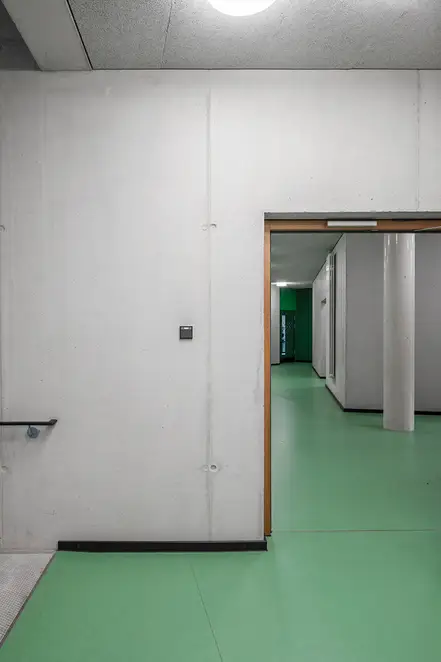
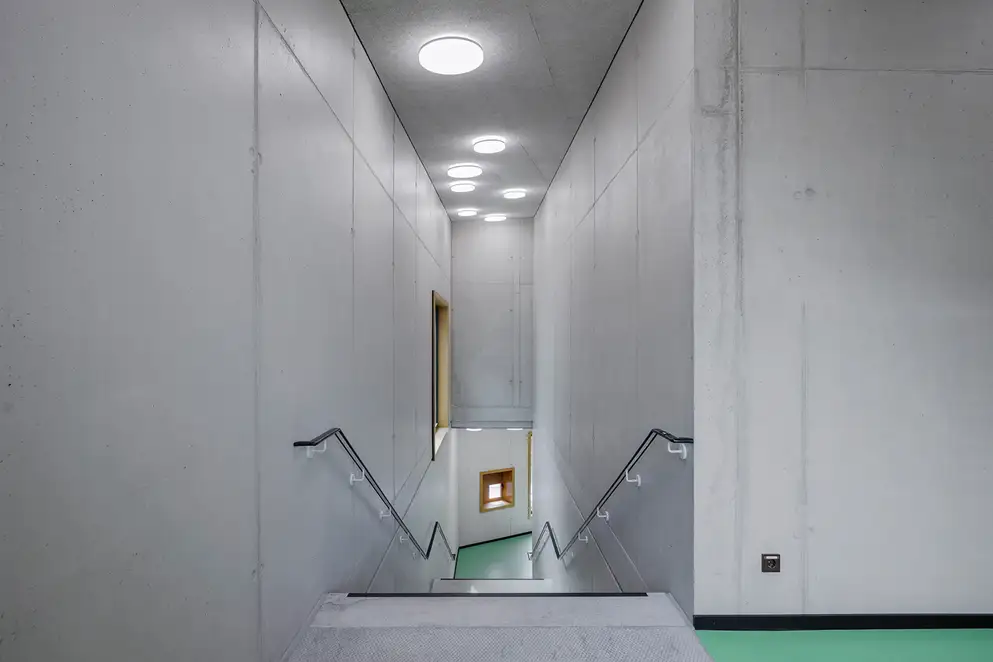
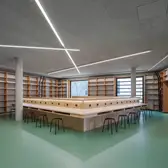
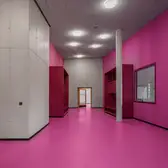
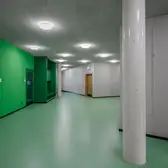
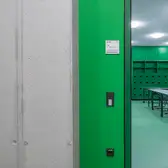
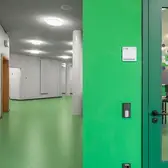
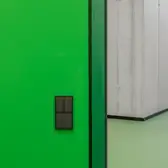
As a result of the jaunty ground plans in the form of pentagons, in the interior, the intermediate and external spaces unusual spatial situations arise. Alcoves, narrow corridors and widening zones permit lively spatial sequences. Between the clusters of classrooms there are locations for withdrawal and for variations of teaching forms. A strong colour concept in light green, orange, blackberry, light and bright blue identifies the various zones and levels. The coloured areas cover wall, floor and fixtures and stand in contrast to the reduced materiality of the exposed concrete walls, wooden windows and stairs as well as the simple interior fixtures. Round, freely arranged, LED lamps provide a uniform warm light.
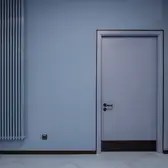
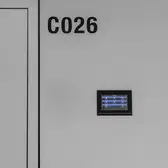
The architectural expression is based on fascinating contrasts: Minimalism meets a variety of forms, robust materials meet bold colours. The decision to choose the formally minimalist LS range from JUNG appears even more stringent. Even the operating elements take their places confidently. Every component is where it has to be. In the self-study zone in the study centre, the sequence of LS 990 sockets becomes a design element – in the end the skilful interplay of simply reduced necessities also has an effect here: stool, wooden worktops, sockets, lighting. LS 990 switches and sockets in the colours LS Dark and white are used throughout the group. Lighting control uses the KNX system with F 50 push-buttons, partially as multiple combinations. On the outside, LS 990 switches find their place in the brick façade. Just like the large glass openings and the smaller wooden window formats, the switches appear to be cut into the clay façade.
The BAN is a “place for education where children form their future”, the architects explain. The task of good school architecture is also to teach “resilience, circularity, climate neutrality – as buzzwords for the future – with the adaptability of materials, durability and sustainability”.
Place |
Köln, Germany |
|---|---|
Technology |
|
Design |
|
Architecture |
gernot schulz : architektur GmbH |
Installer |
Astel GmbH |
Building Owner |
Gebäudewirtschaft der Stadt Köln |
















Used designs und technologies
KNX F 50 push-button sensors
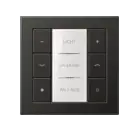
Form meets function in the designs in the AS, A, CD, and LS ranges. The optional transparent or coloured design cover, the RGB LEDs for indicating status and operation as well as the illuminated integrated labelling field with brightness control round off the design concept.
KNX system
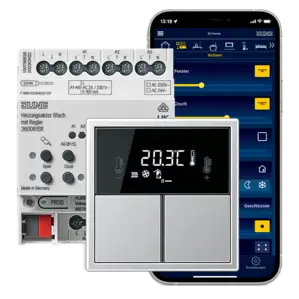
Smart building automation combines convenience, security and energy efficiency. For this reason KNX has already become the standard worldwide for high-class private and commercial construction. The smart JUNG KNX solutions combine function, design and intuitive ease of operation.
LS 990 in Dark aluminium

A prestigious interior derives its appeal from exclusive effects. The design switches in high-grade metal versions satisfy this standard outstandingly well. Cool stainless steel, aluminium or attractive anthracite, chrome or precious gold plating – they lend a special touch wherever the emphasis is on the extra-special. Two variations of genuine brass complement the portfolio: Classic with a bright, softly polished finish, antique suitable for traditional interiors.
LS 990 in white

Thanks to its high quality and clear shape, the LS 990 switch range has already proved its worth for about 50 years. The classic form of this switch with its narrow frame fits harmoniously into any surroundings. Purist elegance in thermosetting plastic or genuine metal lend this series a touch of class. A wide variety of applications are possible thanks to the wide functional spectrum. Thus, architecturally demanding visions can be consistently put into practice. The single to fivefold frames can be fitted horizontally or vertically.