0

Smart Homes: Turning Our Buildings into Protective Guardians

Off the top of your mind, what do you think are the benefits of smart homes? The convenience of controlling the temperature with Alexa from your couch, the comfort of having your lights dim for a special dinner, or perhaps your appliances helping you to save energy. While these make day-to-day life easier, that's not all that smart home systems can do. In this blog piece, we want to present a lesser-known side of smart home systems. They can also help us safeguard what truly matters: the lives of our loved ones.

Although we tend to think that accidents are unlikely to happen, they are unpredictable and pose a lurking threat. Yet, it is also impractical for us to be in constant paranoia for these "what if" situations. Here is where smart homes can come in to serve as our guardian angels. By transforming our buildings into smart homes, equipped with the right sensors and algorithms that automatically react, our homes can become an extra pair of eyes and hands in times of an emergency. Below, we cover three ways that our smart homes can help to look after us and our loved ones by: mitigating potential dangers, providing an early warning, and preventing accidents from happening.

Mitigating Potential Dangers

Falls are one of the most common types of accidents that occur at home, caused by slippery floors, clutter, physical health, or even carelessness. Although sounding seemingly trivial, falls can be serious. At best, we get away with bruises that take too long to heal; else, we suffer from sprains, fractures, or worse. For the elderly or people with mobility issues, there is both a greater risk of falls and more harm caused by falls. Especially for the elderly, the later a fall is treated, the worse its complication can become. To better mitigate the potential harm, it is important for us to be able to quickly identify if our loved ones have suffered from a fall, check in with them, and call for emergency services if needed.
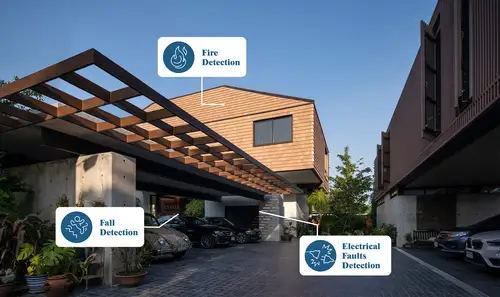
Here's where smart home technology helps, in the example of an elderly person falling in the bathroom due to the wet floor. Ceiling-mounted sensors with artificial intelligence-based technology can be used to detect movement. This is then fed into a machine learning algorithm that learns normal movement patterns such as walking and sitting. When an abnormality is detected, such as when there is a rapid downward motion followed by relative inactivity, the system recognizes this as a fall in real-time and sends a smartphone notification to the caregiver. With this alert, the caregiver can immediately check in on the elderly person and take relevant follow-up actions such as calling for emergency responders if needed. The smart home can also register this circumstance as a special case scenario, unlocking doors to allow emergency responders easy access to the injured. With immediate detection and response, the potential harm a fall causes can be mitigated. On a side note, sensors do not need to be a cause for concern for the privacy of those at home. As a non-invasive solution, sensors can use infrared or radar-based technology instead of cameras to detect stationary pose and movement without recording videos.

Providing an Early Warning

The danger of fire has reared its ugly head recently with the massive wildfires in Los Angeles that claimed the lives of at least 25. Although wildfires may be uncommon in residential areas of our region, other causes of fires such as forest fires, electrical faults, and cooking fires can easily pose a threat. For most victims of fire, they are often the collateral damage of fire from an external source aside from their own homes as it spreads quickly. This is especially significant for the densely populated capitals of Jakarta, Singapore and Kuala Lumpur, where many live in packed neighbourhoods. To protect our loved ones and our belongings from the devastation of fires, the ability to receive an early warning and call for help in advance is greatly beneficial.
Smart homes can help signal an impending external fire through flame sensors placed in strategic locations such as roofs and the facade of the house. These sensors can detect both infrared and ultraviolet radiation that are characteristics of a fire. To more accurately confirm a fire, these flame sensors can be used with smoke detectors and weather stations that register humidity and sunlight, minimizing false alarms. With an algorithm that processes the data from the various sensors, the smart home system can automatically take actions when a fire is detected. This includes alerting the homeowner via a smartphone notification, triggering an alarm in the house to warn occupants, and even calling emergency responders. If the smart home is equipped with fire-fighting capabilities such as sprinklers or fire-resistant shutters, these can be activated alongside the above actions. A comprehensive fire detection set-up in a smart home can provide an early warning before it is too late.

Preventing Accidents

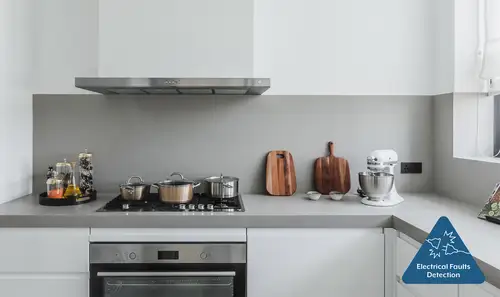
Electrical accidents in the form of electrical fires and electrical shocks do not just occur in places with outdated electrical infrastructure. In modern homes, they can still pose a risk due to the lack of awareness, improper maintenance and unsafe practices by users. These include incorrect DIY installation of electrical components without consulting a licensed electrician, faulty or worn-out insulation on wiring, and overloaded circuits when the safe load limit is exceeded. With more appliances bought from international sources, each with a different voltage, power rating and frequency, there is a higher risk of incompatibility with local electrical systems. By detecting potential electrical faults early and taking immediate action, electrical accidents can be prevented.
A combination of smart appliances integrated in a smart home hub can act as an additional layer of protection against electrical faults. 
1. At the basic level, smart plugs with a built-in temperature sensor can automatically shut off power to an appliance if it gets too hot. They often also have a feature to turn appliances off if it detects that the appliance has not been used for a while. 
2. At the intermediate level, smart circuit breakers can automatically manage power throughout the house by tracking the electrical load across multiple devices in a circuit. When a device is detected to consume power exceeding the safe limit in the circuit, the circuit breaker can cut off the power to the device and prevent it from overheating. 
3. At the advanced level, the smart home system can be integrated with the main electrical panel to provide real-time data on each circuit's energy consumption. If the system detects that a circuit is nearing its load limit, it can automatically balance power distribution across various circuits. They can also conduct diagnostic checks on appliances or the home's electrical system, alerting potential issues before they become dangerous. 

Such preventive measures allow our homes to become a safer space for us to live in.
As technology continues to evolve alongside our desires, we can achieve much more than what we have been able to even just a decade ago. Right now, smart homes can become our guardian angels to safeguard us against accidents. When it comes to technological advancement in smart homes, we should not be asking the question of "What can a smart home do?". Instead, we should be asking "What do I want my smart home to do for me?", fueling innovation according to our needs — even those we have previously assumed to be impossible to meet. With more powerful technology, we can entrust our guardian angels to safeguard us in more ways, allowing one to appreciate life better.