0

Demystifying Wellness Design in Interiors

The Goodpost Studio, New Taipei City, Taiwan. Credits: Ciao,Pie!
Health, which is stated by the World Health Organisation to be "a state of complete physical, mental and social well-being", has been in the limelight since the recent pandemic. This has caused a revitalisation of a previously underexplored approach to architecture and interior design — wellness design. In its essence, wellness design aims to create spaces that facilitate the holistic wellbeing of its users. Albeit in a limited way, ancient architecture is no stranger to this approach. From Greek townscapes that prioritized temples, clinics, and theatres to beliefs of yore such as the Chinese Feng Shui and the Indian Vastu Shastra to usher in positive energy, wellness has always been incorporated as a core tenet for living spaces.
  
However, wellness design in modern architecture can still seem like a vague concept. Oftentimes, only the end goal to create spaces that promote relaxation, comfort, and connection is clear, without a consistent way to achieve it. What exactly is wellness design then? To answer this, we aim to provide clarity to this design concept with concrete objectives. Maslow's hierarchy of needs, a popular theoretical framework to understand human motivation, will be tapped on to illuminate how specific design choices can achieve the goals of wellness design. As an example, an office space that was designed with an emphasis on the wellbeing of its users will be analyzed as a case study. With a clearer understanding of what embodies wellness design for a work environment, similar effects can be replicated and applied to other types of living spaces.
Credits: Data Design
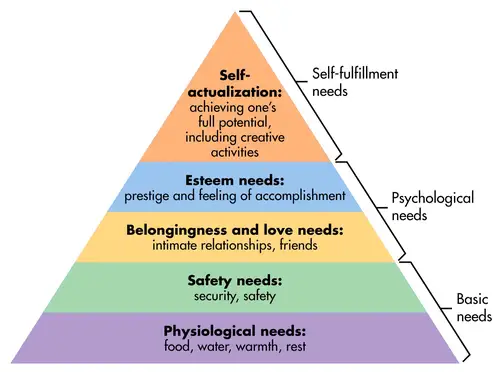
Firstly, a quick glance at Maslow's hierarchy of needs. Among the five tiers, needs can be roughly split into two categories: (1) needs that are the foundation to be functional which includes "physiological needs" and "safety and security", and (2) needs that are about empowerment, such as "love and belonging", "self-esteem", and "self-actualization". To delve into wellness design, we will use empowerment needs to discover the underlying objectives behind certain design choices. These objectives can then be generalized as the core building blocks in creating spaces that support the wellbeing of its users. Foundational needs will not be covered as they are given factors for an office space.
Case study - Goodpost Studio
The Goodpost Studio is a professional video editing studio that is based in New Taipei City, Taiwan. Specializing in post-production and visual effects for television programmes, it is a fast-paced environment where high-quality work with a short turnaround is the norm. To create a comfortable space that facilitates and supports its employees' work in a holistic manner, the studio founder worked together with interior design firm Guudpin Design to craft a workspace that has a subtle positive impact on its employees.

From an interview with Guudpin Design, specific design choices will be looked at with Maslow's hierarchy of needs to draw connections between space planning and the psychological wellbeing of its users. Climbing up the rungs of the hierarchy, design choices that address "love and belonging" as well as "self-esteem" needs will first be covered. Together, they turn a cold office space into one that is warm and inviting. A heavier emphasis will be placed on the design choices that support "self-actualization" needs, as they are the X factors that transform a mediocre office space into one that employees can thrive in.
1. Interpersonal Connections
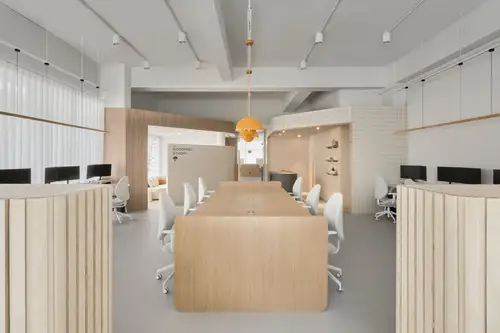
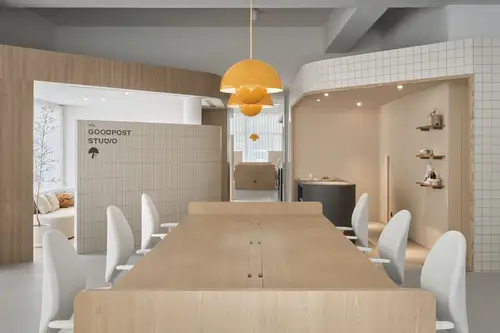
"The large central workspace serves as a place for everyone to communicate."
The Goodpost Studio, New Taipei City, Taiwan. Credits: Ciao,Pie!
For any workplace, a communal area is essential for employees to congregate around for both professional meetings and informal conversations. By intentionally placing the long discussion table in the center of the office, it bridges the gap for communication. This sparks spontaneous meetings and conversations, allowing for stronger relationships between employees to be built which meet the "love and belonging" need.
2. Autonomy and Independence
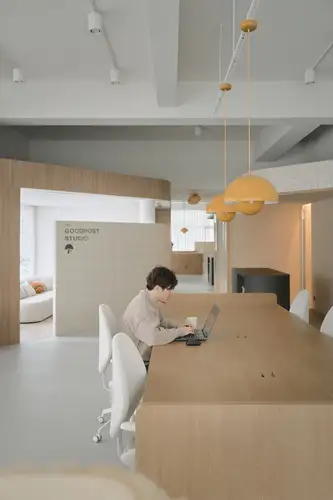
"To balance personal creative space and team interaction, desks are arranged on both sides to ensure that everyone has a quality independent work environment."
The Goodpost Studio, New Taipei City, Taiwan. Credits: Ciao,Pie!
A subtle but significant factor, the implementation of individual desks provides employees with a sense of autonomy that meets the "self-esteem" need. Having an independent space where one can express themselves with personal belongings such as family photos and trinkets allows them to find comfort in a space. In an office setting, where most of the space is shared, providing each employee with a personal, unique space sends a strong message that their individuality is respected and valued by the company. These efforts lead to a stronger connection with the company while having a personalized environment where employees can be comfortable at work.
3. Design for Comfort
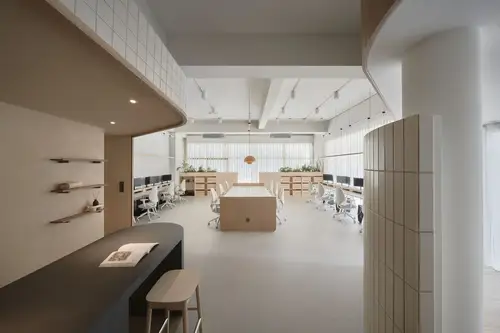
"The design also uses curved walls on both sides to guide the view towards mirrored walls, expanding and enlarging the space. This creates a spacious area with soft, delicate visuals, reducing visual strain, and gently supporting the flow of thoughts."
The Goodpost Studio, New Taipei City, Taiwan. Credits: Ciao,Pie!
Being comfortable in an environment is no doubt beneficial in easing users in and facilitating them to perform. In such a space where their basic physical and psychological needs are met already, they can prioritise "self-actualization" needs like achieving their full potential and creating work that they can be proud of. The ideal comfortable workspace may look different to everyone - some may prefer greenery, and others may prefer cushions. However, what is consistent is the concept of geometry, with curves and organic shapes often synonymous with easing in. Used throughout, curves serve two purposes: to soften the ambiance and to elicit positive emotions in employees. As employees navigate through the office daily, they are gently guided around the inviting space that was designed to reduce mental strain and support their creativity.
4. Avoid Monotony
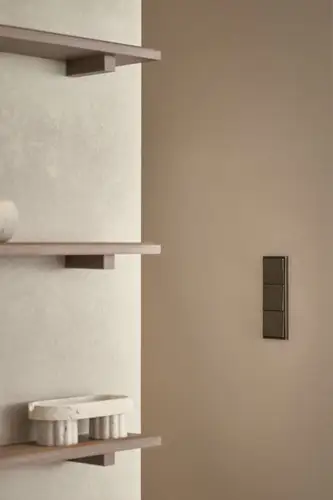
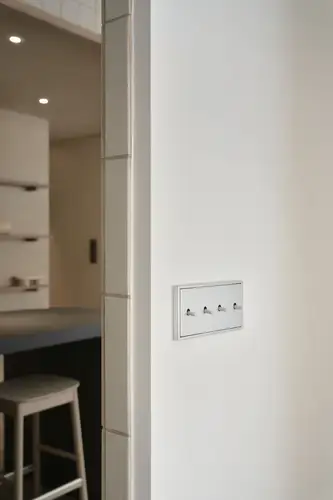
"Chose different series of JUNG switches for various areas, considering their style, colour scheme, and function, making them both subtle and eye-catching decorative elements."
The Goodpost Studio, New Taipei City, Taiwan. Credits: Ciao,Pie!
The materials chosen for fixtures and fittings can significantly impact how a space feels, but what is often overlooked is the importance of variety in these materials used. With the strong influence of minimalism on interior design over the past five decades, it is easy to fall into the trap of creating a "simple and clean" design that may have the effect of being cold, sterile, and uninspiring. For creative spaces like Goodpost Studio, a workspace designed to inspire innovation and creativity helps employees perform at their best, allowing them to meet their need for "self-actualization". By using different color schemes and materials to define distinct zones, the office avoids looking monotonous. Compared to a dull space with repetitive shades of whites and greys, a varied environment creates a dynamic and engaging experience as employees interact with space.
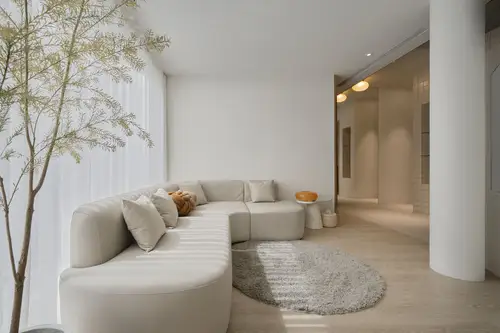
5. Foster Creative Freedom
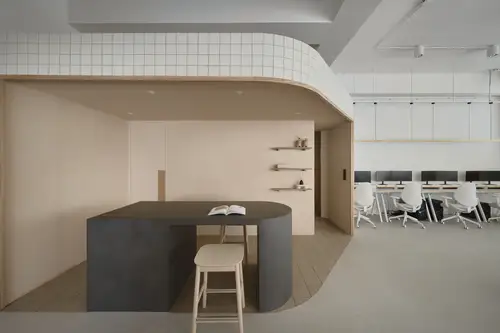
"The functional areas are thoughtfully designed to flow seamlessly into each other, creating a sense of progression throughout space. The open, uncluttered areas provide room for inspiration to strike. This design encourages users to move freely and engage in creative activities."
The Goodpost Studio, New Taipei City, Taiwan. Credits: Ciao,Pie!
Amongst jargons and principles in the concept of wellness design, "decluttering" has been a buzzword, which aims to translate clarity and organization in the physical realm to one's mental state. By extrapolating this idea into space planning, having a clean flow and a bright airy space provides users with a sense of being unconfined, contributing towards supporting one's pursuit of "self-actualization". Compared to office spaces that utilise a segregation approach with boxed-in cubicle workstations, the Goodpost Studio opted for an open, uncluttered area to allow for inspiration and creativity to happen spontaneously. Aside from allowing light to permeate the whole space, this design choice was made to convey the feeling of spaciousness and facilitate an unimpeded flow of movement and thoughts.
Wellness design is a complex concept that focuses on improving the holistic health of users in a space. To achieve such a multi-faceted goal, it is more important to take on the perspective of understanding the needs of the users first, rather than following a checklist of "must-haves" from trends. There are different ways to quantify the physiological and psychological needs that users have for them to survive and thrive, and tapping into Maslow's hierarchy of needs is just one approach. Upon understanding these needs, crafting design decisions that would benefit the wellbeing of users becomes clearer and more effective.